Key Takeaways
- Training completion shows participation, not whether people are better at the job.
- Frontline employees need learning they can reach between tasks, on devices they actually use.
- When training is only the consequence of a mistake, people learn to avoid it.
- A certificate is not capability. Capability is built through exposure, practice, feedback and repetition.
- Effective frontline training needs Reach, Relevance, Reinforcement and Results.
- The real test is what changes on the job, often weeks after the course is complete.
Introduction
Three stories caught our attention this week. On the surface, they have very little in common.
New York
South Africa
HR Indaba
Different industries. Different challenges. But one common lesson for anyone responsible for frontline employee training: we've become very good at delivering training. We need to get much better at building capability.
There's a big difference between someone who has completed a course and someone who can confidently apply what they've learned when it matters. That difference comes down to three things: who gets to learn, how learning makes people feel, and how we know it's actually working.
Why Frontline Employee Training Needs to Change
Think about how training typically works in a frontline-heavy business:
| When this happens | The usual response | |
|---|---|---|
| A new process rolls out | → | Everyone gets assigned a module |
| A product launches | → | Everyone attends a briefing |
| Someone makes a mistake | → | They get sent back for retraining |
From a reporting perspective, the programme looks successful. But what happens on the floor? Can the merchandiser apply the new process? Can the call centre agent handle a difficult conversation? Does the restaurant team remember the correct procedure during a busy service?
Training completion tells you someone went through the process. It doesn't tell you whether they're better at the job.
This is where traditional training starts to fall short. It often prioritises delivery over retention, standardisation over individual needs, and compliance over practical application. Three recent stories offer a useful way to rethink that approach.
Three Stories, Three Lessons for Frontline Training
1. The AI conversation: stop leaving your frontline behind
Most conversations about AI in business happen between people with laptops. Executives discuss transformation, HR teams develop AI strategies and office workers experiment with new tools. But what about the merchandiser in aisle seven? The driver on the road? The call centre agent managing another difficult customer? Their jobs are changing too, yet they're often the last people involved in conversations about what that change should look like.
At the 2026 HR Indaba, an article published by CHRO South Africa explored precisely this challenge. Portia Mogale from Santam Corporate made an important distinction: AI changes tasks before it changes jobs. Rather than assuming entire roles will disappear, organisations need to understand the individual tasks that make up those roles. Which tasks can be automated? Which can be supported by AI? And which still require human judgement, empathy and experience? Only then can we understand what people need to learn.
Karen Hammond from Meridian Group shared how Project ARC is helping employees understand AI, develop new skills and overcome fears about job security. She described tasks that previously took two hours being completed in 30 minutes, creating opportunities for employees to develop other capabilities. That's what can happen when organisations bring people into technological change instead of simply announcing it to them.
AI upskilling cannot remain a head-office project.
If employees can't access learning between tasks, on devices they can use, in formats that make sense for their working day, even the best programme will struggle to reach them.
2. The Knicks story: when training becomes a punishment
The second story comes from an unlikely place: the NBA. According to Yahoo Sports, Madison Square Garden employees received emails inviting them to choose a New York Knicks championship ring. There was just one problem. The offer was actually a cybersecurity phishing simulation, and employees who clicked the link were mandated to attend cybersecurity training.
Madison Square Garden later acknowledged that using championship rings as the lure was a mistake. The security objective was legitimate, because organisations absolutely need to help employees recognise cyber threats. But the way learning was introduced offers a broader lesson.
When training becomes the consequence of getting something wrong, we risk teaching people that learning is something to avoid.
And this happens on the frontline all the time. A poor mystery-shopper score? Back into training. A till variance? Another mandatory module. A customer complaint? Time for a refresher. There's nothing wrong with helping people correct mistakes. The problem is when correction becomes their primary experience of learning, because it creates two challenges:
- Training arrives too late. By the time the mistake has happened, the business has already felt the impact: the customer has complained, the product has been incorrectly handled, the operational standard has slipped. What if training helped employees recognise and avoid the problem in the first place?
- Learning starts to feel negative. If every training notification follows a mistake, employees begin associating learning with criticism, extra work or embarrassment. That makes it harder to build the curiosity and confidence that continuous improvement requires.
The goal should be to turn learning from a push into a pull: something employees return to because it helps them succeed, not simply because someone told them they must. That's where thoughtfully designed microlearning, regular reinforcement, constructive feedback and gamification make a difference. A short challenge that helps someone handle a real customer situation is more useful than another lengthy module assigned after a complaint, and a little friendly competition can make the experience more rewarding.
Training shouldn't be what happens when you get caught. It should be part of how you get better.
3. The SETA conversation: a certificate is not the same as capability
The third story takes us back to South Africa. In an SAnews report published on 23 October 2026, Deputy Minister of Higher Education and Training Yusuf Cassim called on SETAs to measure their success through employment and economic outcomes, rather than simply counting learners trained or certificates issued. He also emphasised the importance of meaningful workplace exposure and work-integrated learning.
His comments concerned public skills development, but there's an important lesson for employers: training has to lead somewhere. A certificate can recognise effort or achievement, but on its own it cannot tell you whether someone is capable of performing a particular task under real working conditions. You can't certify someone into calming an angry customer. You can't assume that completing a stock management module means a merchandiser will consistently identify gaps on a shelf. And you can't expect someone to remember every step of a complicated process after hearing it once.
Capability develops through exposure, practice, feedback and repetition. Think about learning mathematics at school. You weren't given one exercise, shown the answer and declared a mathematician. You practised, made mistakes, received feedback and tried again. Workplace learning isn't so different.
If you can't see the skill, you can't improve it.
The real evidence of training effectiveness appears in the workplace, often weeks after the course is complete. Can the employee demonstrate the expected behaviour? Can they apply the knowledge without constant guidance? Has their performance become more consistent? Managers and supervisors should be able to answer these questions, and if the answer is no, that information should help identify the gap, reinforce the right knowledge and provide targeted coaching.
Completion rates still have their place. They help us understand participation and reach. But they should be the beginning of the measurement conversation, not the end.
A Better Model for Frontline Training: Reach, Relevance, Reinforcement and Results
So what would it look like to combine the lessons from all three stories? We believe effective frontline training needs four things:
If training only works for someone with a laptop, a desk and an uninterrupted hour, it isn't designed for most frontline environments. Learning should fit the reality of the working day.
That means short, mobile-first, data-light experiences that employees can access when they're needed, with appropriate time and support to learn. It also means considering:
For frontline AI upskilling, accessibility is especially important. Employees cannot participate meaningfully in transformation if they cannot access the knowledge needed to understand it.
Before building a training programme, ask the people doing the job where they struggle:
- What takes too long?
- What causes mistakes?
- What information is difficult to remember?
- What would make tomorrow's shift easier?
Then map those challenges to specific tasks and behaviours. Training becomes valuable when employees recognise its connection to their actual work.
This is particularly important when introducing AI tools. Employees need to understand not only how to use the technology, but why it helps them perform their tasks more effectively.
One training session is rarely enough to build lasting capability. People need opportunities to revisit important knowledge, practise recalling it and apply it in different situations.
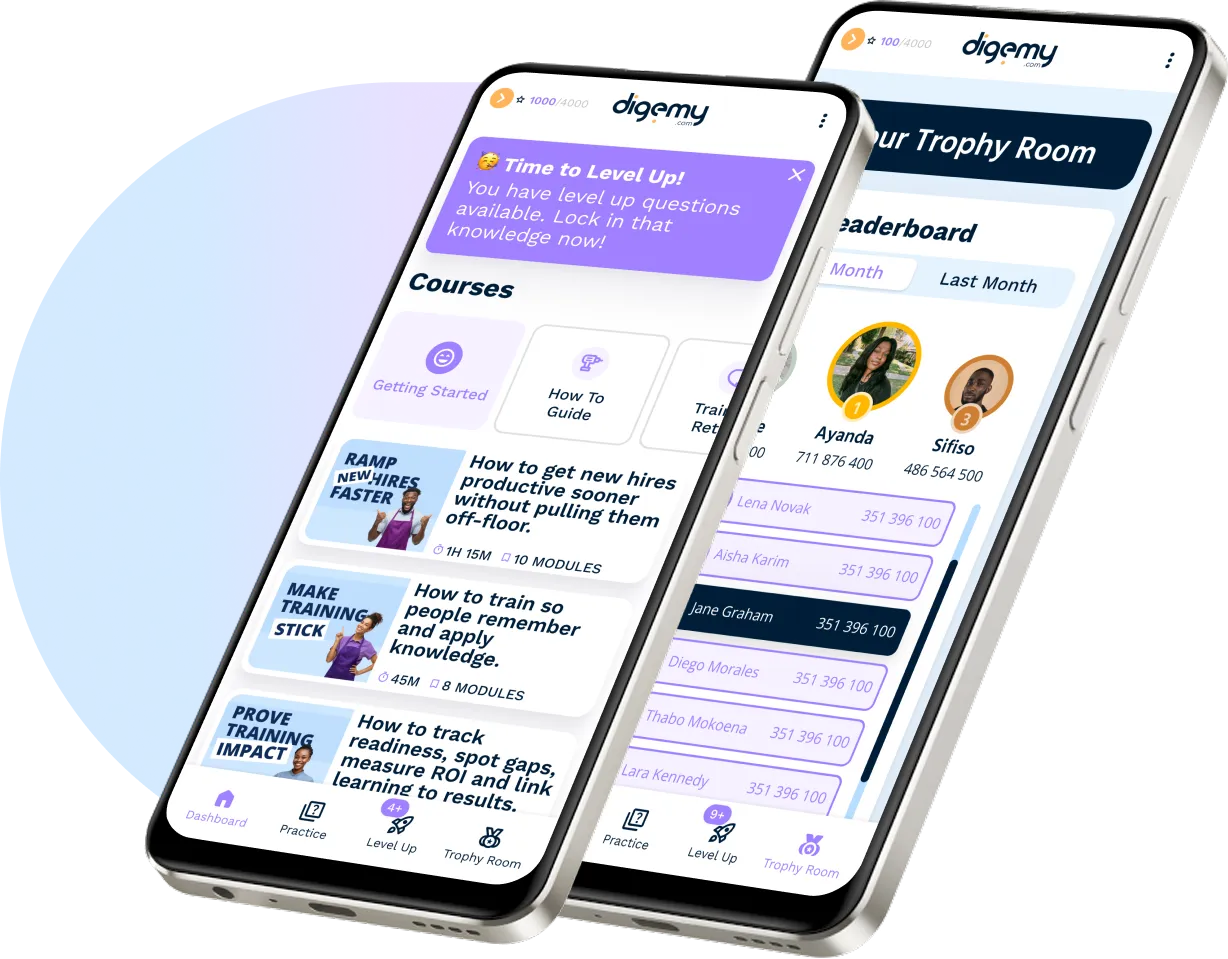
This is where neuroscience-informed approaches such as spaced repetition, retrieval practice and personalised reinforcement become useful. Short learning experiences can build on each other over time, and gamification can add motivation through progress, challenges and recognition, provided the learning remains relevant and supportive.
The goal isn't to make people complete more content. It's to help them remember and use the right knowledge when they need it.
Finally, learning needs to connect to observable performance. Depending on the role, that might include:
- Faster time-to-competency for new employees
- Improved knowledge retention over time
- More consistent execution of operating procedures
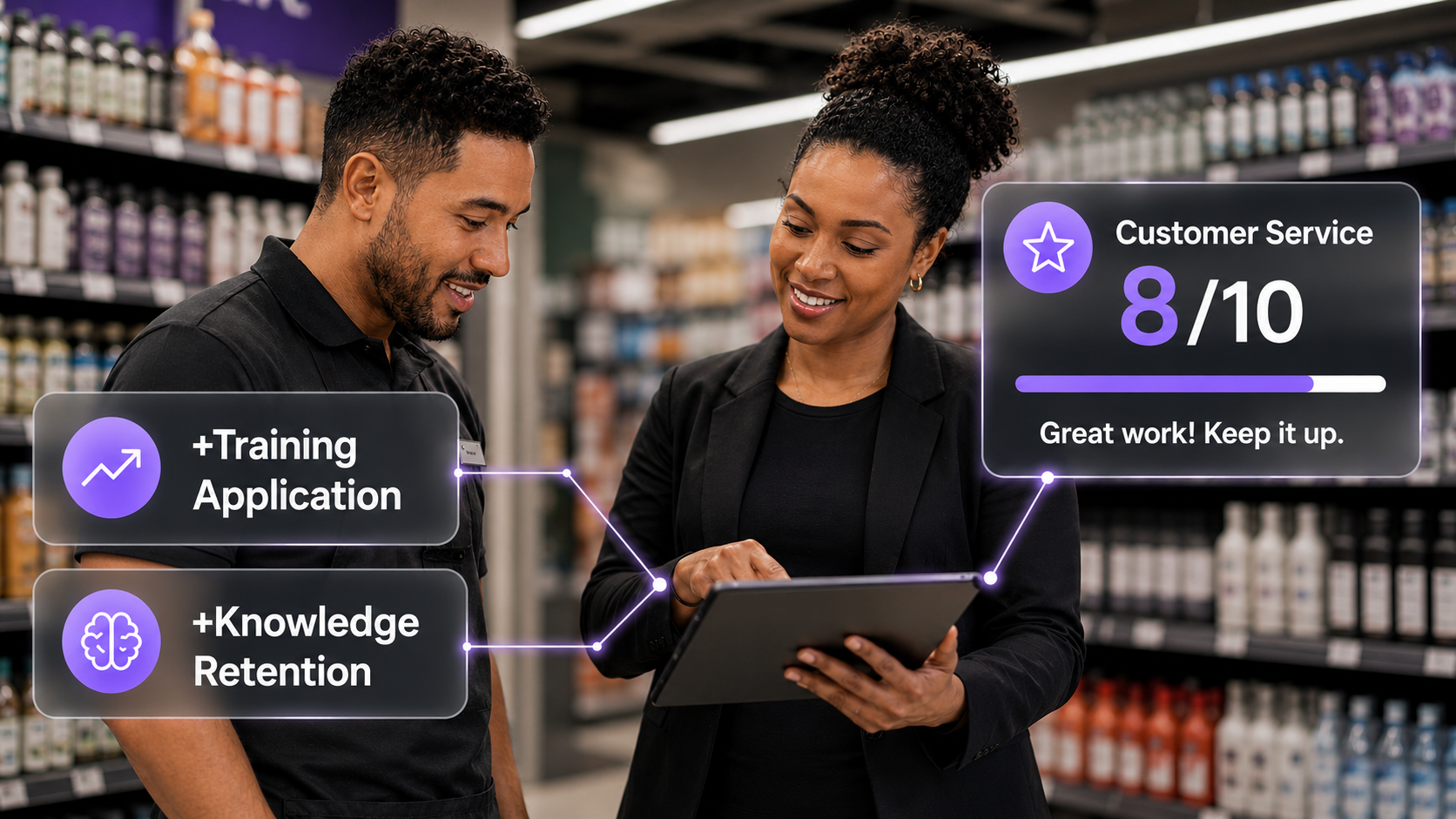
- Better customer service behaviours
- Fewer avoidable errors and less rework
- Greater confidence and independence at work
Managers and supervisors play a critical role here. By using structured observations, performance scorecards and regular coaching, they can identify gaps before they become bigger operational problems, and HR and L&D teams gain a much clearer picture of where their training is creating value.
What This Looks Like in Practice
Imagine a retail business introducing an AI-supported stock planning process across its stores. The traditional approach might involve sending everyone a presentation, assigning a training module and tracking completion. A better approach would start on the floor.
Listen and identify the gaps
Speak to merchandisers and supervisors. Understand which parts of stock planning are difficult, how AI recommendations will affect their tasks, and which decisions still require human judgement. Establish a baseline for task accuracy, knowledge and time taken.
Deliver practical, accessible learning
Introduce short mobile learning experiences focused on specific tasks. Employees learn how to interpret recommendations, identify exceptions and make the right decisions in realistic scenarios. Make time for this during the working day rather than expecting learning to happen entirely outside working hours.
Reinforce and coach
Revisit important concepts through short questions, practical challenges and spaced reinforcement. Supervisors observe employees applying the process and offer support where needed.
Measure and improve
Assess retention, observed task performance and relevant operational metrics. Look for improvement, but also consider other factors that may influence performance. Use the findings to adjust training, improve the process and focus coaching on the remaining gaps.
The result is a learning process that evolves alongside the work, rather than a course that ends when everyone has clicked complete. This is the shift from training delivery to capability development.
The Future of Frontline Employee Training Is About Performance, Not Participation
The three stories we started with point to a shared opportunity. The AI conversation reminds us to include the people closest to the work. The Knicks story reminds us that the experience of learning matters, not just the content. And the SETA conversation reminds us to look beyond certificates and ask what people can actually do.
Together, they show why frontline employee training needs a different approach: one that reaches every employee, makes learning useful and rewarding, reinforces knowledge over time, and measures its application on the job.
At Digemy, that's what we're working to build. We help organisations identify capability gaps, close them through personalised, mobile-first reinforced microlearning, and measure how learning translates into workplace performance. Because the goal was never to get more people through more courses. The goal is to build confident, capable people who perform better every day.
FAQs
Frontline employee training is learning designed for people who work away from a desk: in stores, restaurants, call centres, warehouses or on the road.
To work, it has to fit around shifts, devices, connectivity and language, and its success should be judged by what changes on the job.
Completion shows who went through the process. It doesn't show whether employees remember the content or apply it when the work requires it.
Completion rates help you understand participation and reach, but they should be the beginning of the measurement conversation, not the end.
Start with the tasks AI will change, not the job titles, and involve the people who do those tasks.
Then deliver short, mobile-first, data-light learning that employees can access during the working day, with time and support to learn.
A certificate recognises effort or achievement. Capability is the ability to perform a task under real working conditions.
Capability develops through exposure, practice, feedback and repetition, and it shows up in the workplace, often weeks after the course is complete.
Look for observable change: faster time-to-competency, better knowledge retention over time, more consistent execution of procedures, better customer service behaviours and fewer avoidable errors.
Managers can use structured observations, performance scorecards and regular coaching to spot gaps and close them.