Key Takeaways
- Manager engagement has dropped to 22% globally, according to Gallup, and peak season puts the most pressure on them.
- Feedback improves performance on average, but over a third of feedback interventions make it worse. The difference is in the design: feedback about the task works, feedback about the person backfires.
- The research points to a clear recipe: feedback from a supervisor, given more than once, spoken and written, with explicit targets and an action plan.
- Structured evaluations turn that recipe into a routine a busy store manager can actually run in ten minutes on the floor.
- Four steps get you there: define what good looks like in a skills matrix, build training into the work, make it accessible on a phone, then give managers a simple framework to rate, coach and course-correct.
Introduction
Only 20% of employees worldwide were engaged at work in 2025, according to global research firm Gallup's State of the Global Workplace 2026 report.
And this trend isn't limited to frontline teams. Manager engagement sits at 22%, down 5 points in the last year alone.
One line in the report should worry any business that relies on frontline teams: managers "are increasingly only as engaged as those they lead." Engagement is a two-way street.
A team that is unsure, undertrained and making avoidable mistakes wears down the person responsible for it, and a worn-down manager has less to give back.
And the disengagement bill is enormous. Gallup estimates low engagement cost the global economy about $10 trillion in lost productivity in 2025, roughly 9% of global GDP.
Peak season tests that relationship harder than any other time of year. Store managers are hiring, rostering and inducting seasonal staff while chasing the year's biggest targets. They're expected to be trainer, quality checker and coach, usually with nothing more than a memory of what "good" looks like.
This guide makes the case for structured evaluations as the tool that changes that. Done well, they give managers a quick, fair way to see who needs help, coach to a clear standard and course correct before small slips become habits.
Here's what the research says makes feedback work (and what happens when it backfires), followed by four steps to put structured evaluations in place.
Why Managers Are Running on Empty
In most frontline businesses, the store manager is the trainer by default. Head office designs the induction, and may even deliver the first dose, but the manager reinforces it, on shift, between deliveries and customer queries.
When volumes rise, it's the first thing to get squeezed. A seasonal hire who needed a week of guidance gets an hour.
The result is a manager who spends December fixing mistakes instead of preventing them. And the more time they spend reactively chasing problems, the less time they have for proactive intervention, feedback and coaching.
This matters because managers shape almost everything about a team's experience of work. Gallup estimates that managers account for at least 70% of the variance in employee engagement scores across business units. When Google studied what its best managers did differently in Project Oxygen, "Be a good coach" was the first of the 10 behaviours it identified.
Why? Because a good coach helps their team realise their potential. They ramp faster, perform better and are more engaged. The problem is most frontline managers don't have a structured, consistent framework or a scalable system to support coaching.
And without a shared definition of good and a quick way to check against it, coaching depends on memory, mood and whoever happens to be on shift: exhausting for the manager, confusing for the team, and costly for the business.
Coaching without a standard is just opinion. Give managers the standard, and coaching becomes quick, fair and repeatable.
What the Evidence Says About Evaluation and Feedback
The most interesting thing that studies reveal when it comes to evaluation and feedback isn't that it works. It's that, done poorly, evaluations can do more harm than good.
However, done right, evaluations and feedback can help businesses flip the script on employee and manager engagement. Gallup reports that 80% of employees who received meaningful feedback in the past week are fully engaged. It's what every good manager knows: people want to know how they're doing, and they want it while it still matters.
So what does good look like when it comes to evaluations? A 1996 study found that what separates the good from the bad is focus: feedback loses its power as attention moves "closer to the self and away from the task."
In simple terms: "You missed the upsell prompt on three of five transactions" helps. "You're not a natural salesperson" hurts. Good evaluation is about the work, never the employee's worth.
A later review of audit and feedback (Ivers et al., 2012) gives us more insight into good design when it comes to evaluations:
| What the research found | What it means on the shop floor |
|---|---|
| The source is a supervisor or colleague | The store manager does the evaluation, not a distant auditor |
| Feedback is given more than once | Evaluate in cycles, not once at the end of probation |
| Delivered both verbally and in writing | A quick conversation on the floor, plus a scored record the employee can see |
| Includes explicit targets and an action plan | Every rating ends with one clear next step |
A Four-Step Framework for Coaching That Scales
Frameworks don't only help managers coach. They make good coaching repeatable, so it doesn't depend on which manager you happen to get. (Yes, we see the irony of answering a framework problem with a framework. In our defence, we really do love a good framework ;-)
Here's the four-step framework we use with frontline businesses:
- Define what good looks like with a skills matrix.
- Map training to skills and build it into the work.
- Make it accessible on the floor.
- Make it measurable: rate, coach and course-correct.
Step 1: Define what good looks like with a skills matrix
To state the obvious, you can't evaluate against a standard nobody has defined.
A skills matrix is that standard: a short list of the skills each role needs, with a description of what each level looks like in practice. It gives managers and staff the same picture of "good", which is where fair feedback starts.
When drafting your skills matrices:
Keep it small. Six to ten skills per role is plenty, and each one should be something a manager can see happen on the floor. "Good customer service" is too vague to rate. "Greets every customer within ten seconds and asks an open question" can be observed in a single shift.
Use the same four levels, so ratings have the same meaning for every skill across stores and functions:
- Learning: knows the basics, needs guidance every time.
- Doing with support: does it correctly most of the time, with occasional help.
- Independent: does it right, consistently, under pressure.
- Can teach it: does it well and helps others get there.
Here is what part of a matrix might look like for a retail sales assistant. The "Independent" column is the one that matters most, because it's the target for every new hire:
| Skill | What “Independent” looks like | How a manager checks it |
|---|---|---|
| Till and payments | Processes cash, card and tap with no voids or variances across a full shift | Watch three transactions; check the end-of-shift report |
| Returns and exchanges | Applies the returns policy correctly, including no-receipt cases, without calling a supervisor | Observe or role-play two returns |
| Customer approach | Greets within ten seconds, asks an open question, offers a relevant add-on | Observe three customer interactions |
| Product knowledge | Explains the top ten lines in their area, including key features and prices | Quick five-question check on the floor |
| Loss prevention | Spots and follows procedure for label switching, fake returns and distraction tactics | Talk through two scenarios |
| Health and safety | Keeps aisles and fire exits clear, reports hazards straight away | Walk the section together |
Build the matrix with your best store managers, not just head office. They know which skills actually make or break a shift, and they'll use a framework they helped write.
Step 2: Map training to skills, then build training into work, not around it
Once you know what good looks like, map every skill in the matrix to a training intervention.
This on its own can prove an invaluable exercise. Most businesses find gaps straight away: skills that matter on the floor but are only covered once in induction, or not at all. Fill those gaps with short, actionable frameworks tied to a single skill, not another hour-long module.
Then move learning closer to the moment it's needed. A cashier learns the no-receipt returns process best just before their first shift, and again a few days later. A sales assistant remembers new stock details if they get a two-minute refresher the morning it hits the floor.
Training that fits into the rhythm of a shift survives the workday. Training that happens once, off the floor, mostly doesn't.
Repetition matters as much as timing. Memory fades fast after training unless it's revisited, a pattern first mapped by Ebbinghaus and confirmed in a modern replication of his forgetting curve. Short, spaced refreshers on the skills in your matrix keep knowledge alive long enough to become habit (we unpack why in our guide to the Application Ladder).
The practical test is simple. For each skill in the matrix, ask four questions: What does good look like? Where is it taught? When is it reinforced? What happens on the floor when it goes wrong? If you can't answer one of them, that's your next piece of content.
Step 3: Make it accessible on the floor
Frontline staff don't sit at desks, many don't have a company email address, and seasonal hires may only be with you for eight weeks. If training needs a laptop, a login they'll forget or a trip to the back office, it won't happen during peak season.
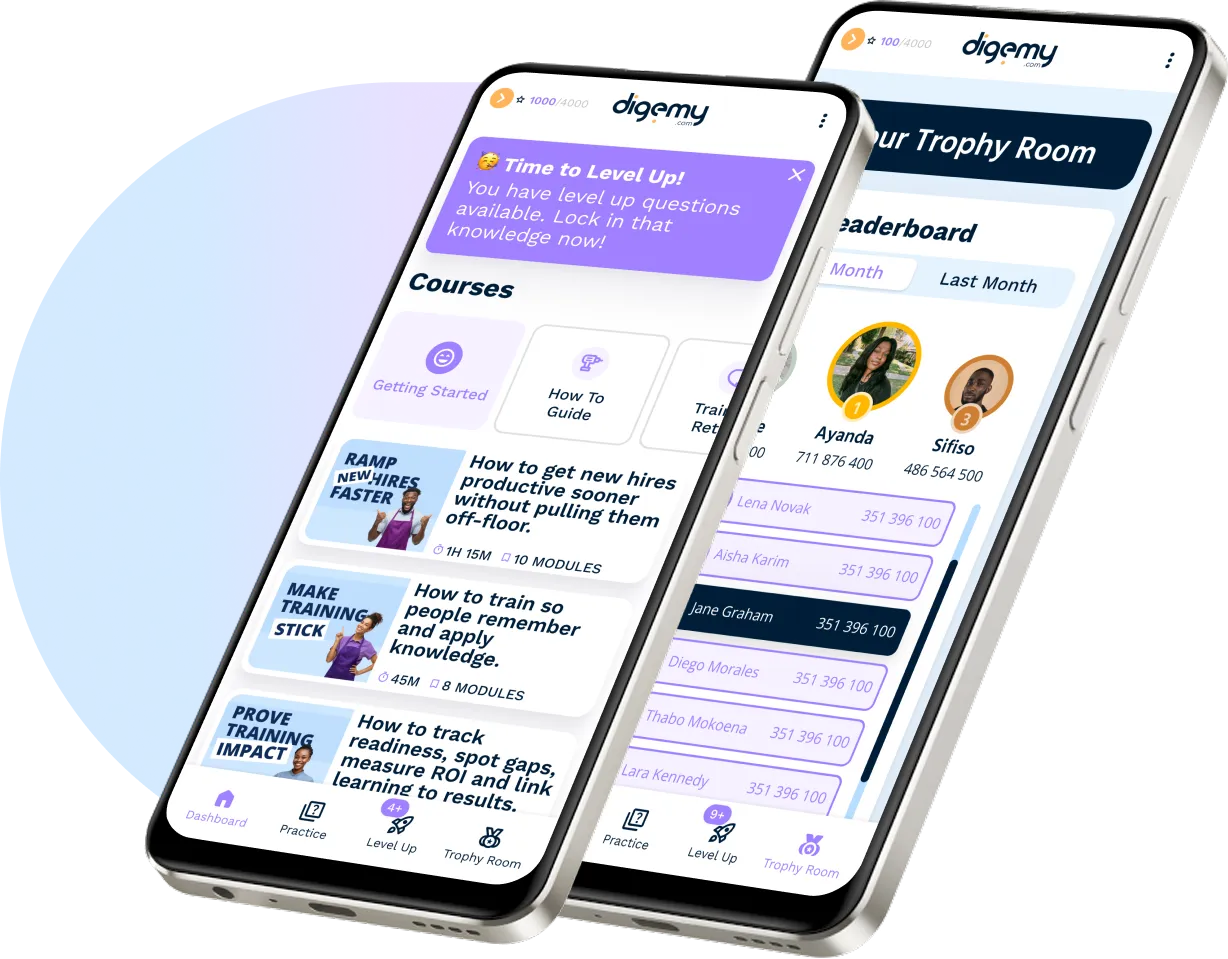
The phone in their pocket is the only device you can count on, which is the core difference between a desk-built LMS and a microlearning platform.
In South Africa, accessibility also means cost and data considerations. Having to download and store an app shouldn't be a barrier to learning. And content should be light enough to load on a basic smartphone without eating into someone's airtime budget (better yet, learning platforms should be reverse-billed so employees learn at no cost).
Raise the bar for skills, but keep the bar for access low:
- One tap to start: a link by SMS or WhatsApp, no complicated sign-up.
- Two to five minutes per session: short enough to finish in a quiet moment on shift.
- Works on any smartphone: small files, no app-store hurdles for temporary staff.
- Clear relevance: every piece maps to a skill in the matrix, so staff know why it matters.
Step 4: Make it measurable: rate, coach, course-correct
This is where the matrix earns its keep. A structured evaluation is simply a manager observing a skill, rating it against defined levels and agreeing one next step with the employee. It takes ten minutes, it happens on the floor, on the manager's phone, and it follows the same loop every time.
The matrix anchors the loop: managers observe and rate against it, coach to the next level, and repeat until the skill holds.
Making that loop work across every store comes down to four things:
- A rhythm, set by skill level, so evaluations happen often while people are learning, not when someone remembers.
- A consistent coaching conversation, so every employee gets the same quality of feedback.
- Guardrails, so evaluations stay fair and trusted.
- Visibility at every level, so you can course-correct for one person or the whole network.
Let the level set the rhythm
The research is clear that feedback works best when it's frequent and repeated, and Gallup finds employees who get daily feedback from their manager are three times more likely to be engaged than those who get it once a year or less. So don't schedule evaluations by the calendar. Schedule them by skill level: frequent while someone is learning, tapering off as the skill holds.
| Current level | How often | What it looks like |
|---|---|---|
| Learning | Every shift | A two-minute spot check on one skill: observe, give one tip |
| Doing with support | 2–3 times a week | A SHIFTS coaching conversation on that skill |
| Independent | Every two weeks | A quick re-check to confirm the skill holds under pressure |
| Can teach it | Monthly | They coach a colleague while you observe |
Someone moves up a level after two ratings in a row at that level. New and seasonal staff start at "Learning", so they get coached every shift in their first week, and the cadence relaxes on its own as they progress.
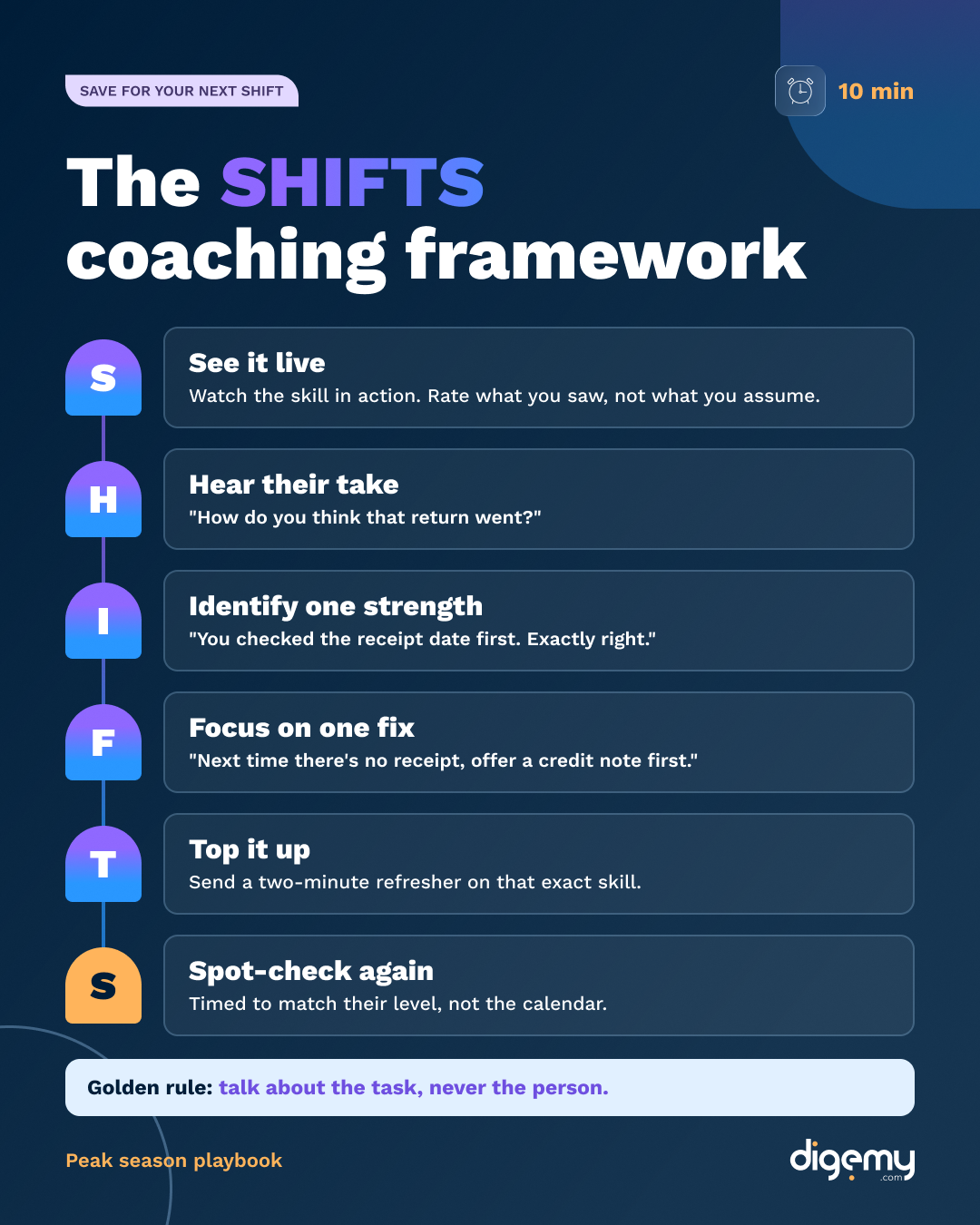
Run a SHIFTS coaching conversation
Six steps, ten minutes, and easy to remember on a busy floor:
- See it live. Watch the skill in action, or ask the employee to talk you through a real scenario. Rate what you saw, not what you assume.
- Hear their take. "How do you think that return went?" Most people know where they slipped, and owning it makes the fix stick.
- Identify one strength. Be specific: "You checked the receipt date before anything else. That's exactly right."
- Focus on one fix. One, not five, and keep it about the task: "Next time there's no receipt, offer a credit note first."
- Top it up. Send a two-minute refresher on that exact skill, so the learning carries on after the conversation.
- Spot-check again. Don't leave the re-check to a diary. Schedule it at a system level, so the manager gets a timely reminder and the follow-up happens at the right interval for that person's level, every time.
Keep it fair
Feedback that drifts from the task to the person can make performance worse. A few guardrails keep evaluations useful and trusted:
- Rate the skill, never the person. "Returns: Doing with support" is feedback. "Not a people person" is a verdict.
- No surprises. Staff should see the matrix on day one and know exactly how they'll be evaluated.
- Two observations before a low rating. One bad transaction during a rush is not a pattern.
- Keep it for development. If evaluations feel like a disciplinary file, people hide mistakes instead of fixing them.
Course-correct at every level
Once ratings are captured consistently, they add up to a picture no manager could hold in their head. A store manager can see which people need help with returns this week. A regional manager can see that every store is weak on the same loss prevention scenario.
That second view is the important one. When one person struggles, coach the person. When half the network struggles with the same skill, the problem is the training or the process, and that's where to fix it. It's what moving from completion to capability looks like in practice.
None of this should rely on a manager's memory or goodwill. As James Clear puts it, we don't rise to the level of our goals, we fall to the level of our systems. Coaching is no different. When the system schedules evaluations, sends the reminders and rolls the ratings up, consistent coaching stops being a heroic effort and becomes the way the business runs.
Give Managers the Structure, and They'll Do the Coaching
Store managers aren't disengaged because they don't care. Many are overloaded because they're asked to train, assess and coach with no shared standard, no system and no time.
Structured evaluations take a lot of that weight off. The skills matrix defines good, short refreshers on the phone do the repetitive teaching, and a ten-minute evaluation turns a vague feeling into one clear next step.
Staff win too. They know what's expected, they hear how they're doing while it matters, and they can see themselves progress from "Learning" to "Can teach it". That's what a fair, well-run workplace committed to growth and development feels like on the shop floor.
Peak season is the hardest time to start, but it's also when the gap is biggest and when competition is fiercest. And a completion report won't warn you that frontline employees aren't ready for customers.
Completion is a lagging indicator: by the time it shows a problem, the target has already been missed. Tracking knowledge retention and evaluating application are leading indicators. They show you where performance is slipping while there's still time to step in.
FAQs
A short, repeatable check where a manager observes a specific skill, rates it against a shared standard and agrees one next step with the employee.
It differs from an annual review because it's frequent, focused on one skill at a time and done on the job.
A skills matrix lists the skills each role needs and describes what each level of competence looks like in practice.
It gives managers and staff the same definition of "good", and it's the yardstick evaluations are measured against.
A weighted scorecard rates several skills or behaviours and gives each one a weight based on how much it matters to performance.
The overall score then reflects what's most important in the role, not just an average of everything.
Microlearning delivers training in short, focused pieces, usually two to five minutes long, each covering a single skill or idea.
It works best when it's reinforced over time, so knowledge is revisited before it's forgotten.
An LMS, or learning management system, is software that stores, assigns and tracks training, usually by course completion.
Most were built for desk-based employees, which is why frontline teams often need a mobile-first alternative.
A leading indicator shows whether training is working before results are affected, such as knowledge retention scores or evaluation ratings.
Completion rates are a lagging indicator: by the time they reveal a problem, the target has already been missed.